Friday, March 24, 2017

Lettuce!

If you've been following the blog, back in mid-January I went stir crazy and decided to start growing some lettuce. Yesterday I had the first delicious salad made from my home-grown lettuce. It was about two months from seed planting to harvesting. The seed packet was correct!


Four generations of lettuce...

These varieties are looseleaf lettuces, which are harvested by picking off only a few leaves at a time off of each plant. The picture at the top is of the three lettuce plants I just picked the outer leaves off of. As you can see, they still look great and will continue growing new leaves in until the weather gets too hot and they "bolt," aka- start flowering. The reds seem to do better in direct sun, and look gorgeous next to the bright green. I love the variety in this mixed looseleaf lettuce seed I bought.

I've been phasing my lettuce plantings so I've got several generations of lettuces growing at this point. I think once the current 3 day old seedlings mature, that'll be the last batch for spring. After that I'll be starting the bean and cucumber crops! 

The newest baby lettuces

Lettuce grows best in cool to moderately warm weather. On nights under around 27F I brought all of my looseleaf lettuces inside. (Kale stayed out until 18F). Usually, though, the nights were mild enough that I could just leaf them out there. Haha...leaf. 

Kale is in no danger from light frost...just from squirrels!
The one in the middle got damaged by a squirrel despite the cage. :(

Lettuces and other cold-weather crops have the ability to survive because they can increase the amount of sugars they produce in their leaf cells. Normally plants get frostbite when the water inside their cells bursts the cell walls. That's why they go all mushy. Cold tolerant plants use sugar as an antifreeze, to lower the freezing temperature of the liquid in their cells. That's why lettuce and kale taste sweeter if grown in cold weather! 

Look at that colorful bowl of sweet, sweet salad greens. Mmmm.

I hope to start getting most of my salad greens from my garden instead of the grocery store in the next few weeks as the plants all start to mature. Hooray growing food! :D

Sunday, March 12, 2017

Arduino Adventures in Cat Entertainment

Arduinos are little computer boards that come with all sorts of sensors, motors, lights, and other fun add-ons that you can use for projects. Starting with lighting up an LED, the Arduino guides available online for free can get the brain-juices flowing and soon you end up with...well, you end up with this.

The Self-Operated Cat Treat Feeder

Ticky now has a cool fun toy that gives him treats when he pushes a button. The trick is now to get him to relate button-pushing with treat-getting. (And also to keep too many treats from being released out of the tube at once.) He's working on it. We're currently to the "paw at the button and Allison pushes the button for me" phase and it's only day one. Give it time.

Here's a quick breakdown of the parts: 

Electronics: 
-  Arduino Uno board
- Breakout breadboard
- 10 kOhm resistor (servo circuit)
- 220 Ohm resistor (LED circuit)
- Pushbutton
- LED 
- 5V servo motor
- various lengths of jumper cable and soldered-on 22 AWG wire

Mechanical: 
- A crapton of duct tape. Like a LOT of duct tape
- 2 Cereal boxes
- 2 round plastic containers w/lids (I think they had cashews in them originally)
- The cap off of a bottle of Ranch
- A bubble tea straw

Tools: 
- Soldering iron (tiny tip) and solder
- Wire strippers
- Wire cutting pliers
- Scissors
-Exacto knife
- Hot glue gun
- Computer w/(free!) Arduino software installed
- USB cable for the Arudino

Tools I WISH I had purchased for this:
- One of those wire-gripping gooseneck gadgets that I see the technicians at work use, because it is GODAWFUL to try and hold wires in place next to each other with tape.
- Ohmmeter, because it's nice to know that it's your soldering's faulty, not your component, rather than guessing.
- Solid core wire, not stranded wire. I have no idea why I purchased stranded wire. I guess I hated my future self. (Or more likely didn't look at it closely enough when I bought it.)

Ticky says he can solder too. And by solder he means sit on my work area.
I had to sequester him to the bedroom during actual soldering. I was afraid he'd burn himself jumping up to investigate.


I started out with combining the example codes from the Servo Motor example, the Button example and the Blink Without Delay example from the Arduino's Examples folder. I wanted to be able to move the servo motor 90 degrees and back again in a certain length of time when I pushed the button. The motor would have a little plastic arm attached to it which would block the bottom of the treat straw when closed, open when the button was pushed to drop a treat, then close the straw back up. The LED was just a last minute addition because it was neat to have a light indicator when the button was pressed. I'll include the code at the bottom of the post for people who want to try it. I don't have any Fritzing diagram software installed, so you'll just have to figure out how to do (individually) Button Circuit, LED Circuit, and Servo Circuit. They aren't really combined on the board itself. The software handles the inputs and outputs. Just make sure you're following the diagrams from Examples 1, 5, and 8 in the Arduino SIK User Guide: https://learn.sparkfun.com/tutorials/sik-experiment-guide-for-arduino---v32/all


Then came the hard part: Soldering. I've only soldered maybe three things in my entire life, way back at the beginning of undergrad, and had no idea what I was doing back then either. I practiced first on some lengths of wire before I switched over to my actual hardware. Turns out that was a good choice, as I destroyed several wire ends with over-cooked solder. Once I wasn't routinely frying wires or dribbling solder all over, I soldered wires to the ends of the LED and the pushbutton to extend them out so they could be used off of the breadboard. I also had to tin the ends of the wires that would go into the breadboard because for some reason I bought stranded wire??? I need to get solid core.

I taped everything into the inside of a cereal box, and then cut a slit in the corner for the servo arm to move 90 degrees through. The straw was taped just above that. A hole was cut nearby for the LED to poke through. I duct taped the jumper cables to the breadboard and the Arduino before putting them in the cereal box just to make sure they didn't pop loose.

Top view of cereal box housing
(Arduino power plug needs to be facing up...
That was fixed for this pic. haha.)

Cutting a side door in the housing makes the breadboard easier to get to!

The treat hopper arrangement.
The Cinnamon Toast Crunch flakes look excited about it?
The pushbutton was mounted to an inverted round plastic container, pushbutton poking through a hole cut in that. Then a second plastic container with a hole for the Ranch lid was positioned on top of the first container to act as a guide so the Ranch lid button slid up and down but didn't fall off.

Button Assembly

The Ranch lid was initially too deep, so I cut some cardboard to shove in the bottom of it to make it the correct depth for pushing the button with one bop of a tiny paw.

Then I duct taped everything down so it isn't suuuper easy for Ticky to destroy. He still can if I leave him alone with it, but hey- its prototype stage.

Ticky has been trying it out, but I don't have any good pictures of it yet because I'm trying to keep him from destroying the machinery in search of treats at the moment. I do have a video of it working though! It's apparently too big for Blogger but I've posted it on my Facebook page. I hope to create more cool Arduino stuff in the near future!

Code for the Arduino:

//This code was created to drive a servo motor and light an LED
//with the push of a button.

#include <Servo.h>  // servo library

Servo servo1;  // servo control object
const int pushButton = 2;     //pushbutton on digital pin 2
const int ledPin =  13;      // LED on digital pin 13

void setup()
{

  // Attach tells the Arduino to begin sending control signals
  // to the servo. Servos require a continuous stream of control
  // signals, even if you're not currently moving them.
  // While the servo is being controlled, it will hold its
  // current position with some force. If you ever want to
  // release the servo (allowing it to be turned by hand),
  // you can call servo1.detach().

  servo1.attach(9);

  // initialize serial communication at 9600 bits per second:
  Serial.begin(9600);
  // make the pushbutton's pin an input:
  pinMode(pushButton, INPUT);
   // initialize the LED pin as an output:
  pinMode(ledPin, OUTPUT);
}


void loop()
{
  int position;
  int buttonState = digitalRead(pushButton);

  // print out the state of the button:
  Serial.println(buttonState);
  delay(1);        // delay in between reads for stability
  //Note: Still playing with the above two lines.
  //Can't seem to print in real time with it.

  // check if the pushbutton is pressed.
  // if it is, the buttonState is HIGH:
  if (buttonState == HIGH) {
       // turn LED on:
    digitalWrite(ledPin, HIGH);
     // Change position if button pressed:
  servo1.write(0);    // Tell servo to go to 0 degrees

  delay(200);         // Pause to give it time to move

   servo1.write(90);    // Tell servo to go to 90 degrees
//
//  delay(1000);         // Pause to give it time to move
  } else {
    // turn LED off:
    digitalWrite(ledPin, LOW);
  }

}


Tuesday, February 28, 2017

Space Crops

In a fun parallel growth cycle, my lettuce seedlings and the lettuce on the International Space Station have been maturing at approximately the same rate this past month. Astronaut Peggy Whitson harvested the ISS crop of Chinese cabbage on Friday, saving some leaves for eating and some for sending back to Earth for analysis. My lettuce just got big enough to transplant it into the garden containers. Unfortunately the Veggie grow container on the ISS isn't big enough to hold full-grown lettuce, so they had to stop while the plants were still small. 


My lettuce grown in my apartment on the ground
The cabbage grown in the Veggie module on the International Space Station

Plants are hard enough to grow on the ground, so why do we grow plants in space? Astronauts on several different space missions have grown, harvested, and even eaten plants they grew while in space. They have been grown for a variety of reasons. The following are just a few:

Arabidopsis, a weed with a very well mapped genome, is used for all kinds of experiments both in space and on the ground. Astronauts used this plant to study root growth in the APEX-TAGES experiment. It turns out roots don't grow down because of gravity! This meant that plants could grow perfectly well without gravity. 


Wheat was grown on the Mir space station to study the effects of space flight on future generations of plants. Wheat seeds from plants grown in space were planted and scientists found no difference between them and the control group grown and re-seeded on Earth. 

Last year Zinnias were taken to the space station and flowered, showing us that flowering plants can also be grown in space, given the right care. Astronaut Scott Kelly earned the title "autonomous space gardener" after he saved the crop from mold damage by assessing crop conditions and adjusting accordingly. Don't talk to me about space flower. I get emotional. lol. 

Space Flower, tiny pioneer for flowering plants

If we are going to go visit other planets someday we have to know how to grow healthy plants to take with us for food. Lugging enough food for a few years' stay on a faraway world is nearly impossible. Carrying seeds is less so. Sometimes I wonder if the plants wanted to go to space all along, and we're just their mode of transportation. ;) 

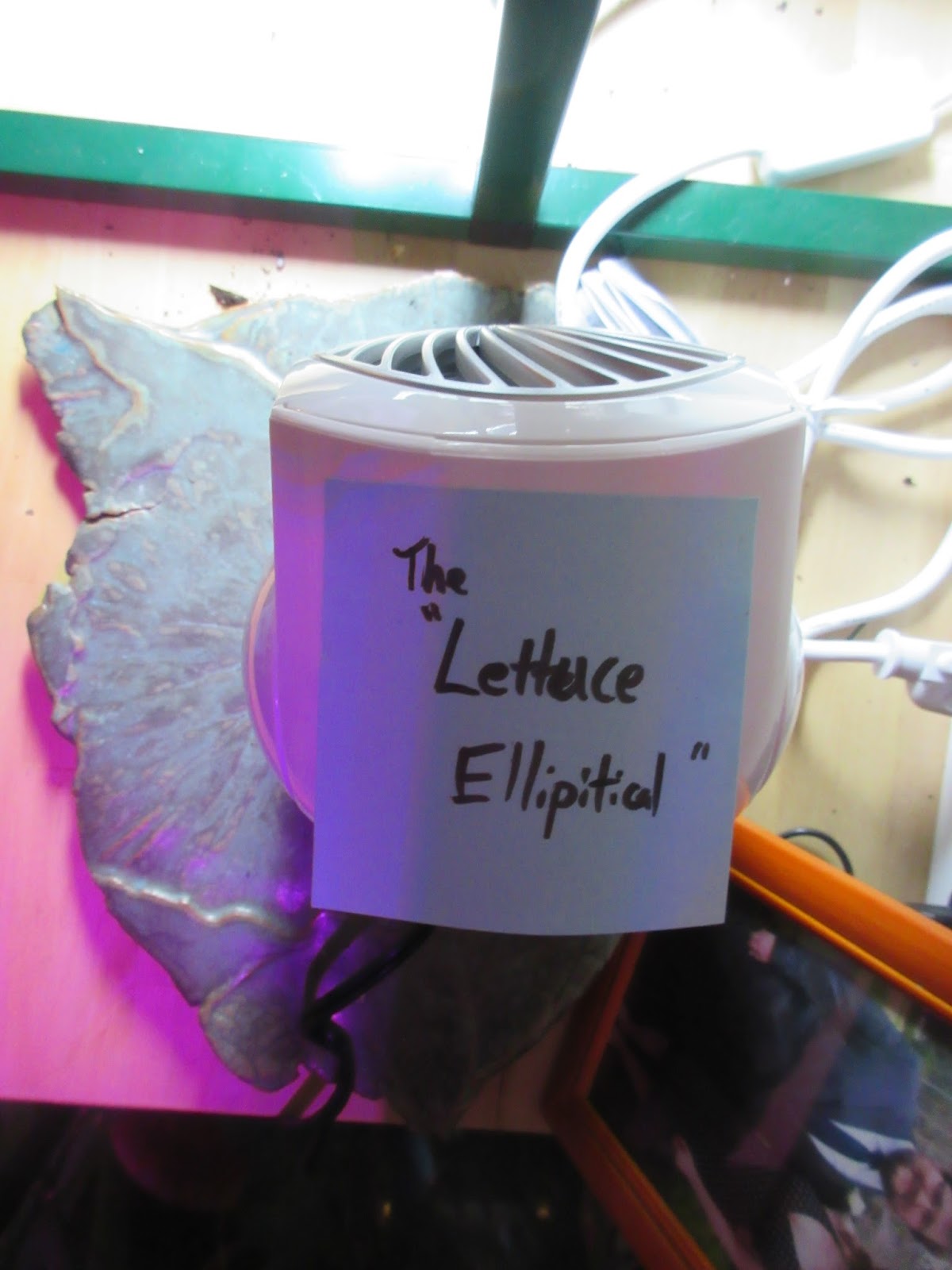
Back on Earth my lettuce crop needed the same things as the space plants for awhile, since it was too cold outside to grow them. They had grow lights on a timer to keep them well fed, were watered in little cups full of soil, and even had exercise. That's right- just like people need exercise to grow big and strong, so do plants! I set up a fan to blow across the seedlings for an hour or two every day to encourage their stems to grow sturdier. We jokingly called it the lettuce elliptical. 

My seedlings have their own personal gym.

All of that care has paid off. Now that the weather has warmed up enough my lettuce is outside where it can get natural sunlight, water, and breezes. On the space station... the lettuce is harvested for research. The next crop is being installed and given its first good watering under the purple-tinted LED lights. Soon there will be a second Veggie habitat installed, giving twice as much room to grow! Someday maybe we will be harvesting lettuce on Mars, boldly growing where no food has grown before.


PS: If you would like to grow plants that have grown on the International Space Station, try these varieties! They are also sold here on Earth. :) At some point I'll have a themed garden which contains only plant varieties grown in space...
- "Outredgeous Red Romane" Lettuce
- "Tokyo Bekana" Chinese Cabbage
- "Profusion" Zinnias
- Mizuna Lettuce (Unsure of exact variety)
- "Super Dwarf" wheat

Saturday, February 11, 2017

Slow Lessons with Horses

It's been about a year and a half since I started volunteering at The Big Purple Barn. I've fed and brushed every horse there. I've picked up everyone's poop and hauled everyone's water bucket. I've even picked most horses' hooves and put lots of blankets on. (Both myself and the horses in some cases. hehe.) I've seen a lot of changes in myself since I first arrived there, both physically and mentally. I can pick up and sling hay bales around first of all, which is useful.


Yeah bro, I lift.

I've gotten better at throwing poop accurately into the wheelbarrows from the inside of the stall instead of having the fork catch the side and dump poo everywhere. (Pee-soaked sawdust is even worse to dump everywhere.) I manage to mostly remember to take small steps when hauling full wheelbarrows so I don't run it into my heels, lift from the legs not from the back, and keep my feet out from under horsey hooves. 

Mentally I'm learning the difference between "yelling" and "screaming," which appear to be two completely different things. Yelling is when you're doing something slightly differently than its supposed to be done, or when you're too far away to hear the directions at a normal volume, and screaming is when you're in imminent danger and need to GTFO now. I'm slowly learning to only freak out when "screaming" is occurring, a process that I think many of the horses have also learned over time. lol. Mental improvements also include being more attentive to detail, something that I've tried to improve on for years that is just now getting a big boost. The "something about this is different, I wonder why it's put there that way" thought process is really useful when working at the barn. I'm even slowly learning all the necessary steps to put Abby in the upper field properly, or let everyone out for breakfast properly, or dear God not to lead a horse through the wrong field if other horses are out. (There was screaming involved in that one). All of these require memory and awareness of where I am and what I'm doing at that moment. It's a bit zen, in an active sort of way. 

"I impart my wisdom, two legged one, and also promise
not to crush your puny skull beneath my hoof."

My favorite form of lessons is from the horses themselves. These are slower lessons, as the horses communicate in their own speech instead of mine and sometimes it's hard for me to interpret. A lot of it is observing them when they're communicating with each other, then trying to apply it to their interactions with me. Sometimes I fail at it. I tried getting Jewel to move her head away from me without touching her and she didn't pay a bit of attention to it until I was forcibly pushing on her cheek. Other times it's worked pretty well. I can get Maggie to move out of a stall I have to clean just by moving toward her or standing and staring at her intently. 

"Stall inspection! May I come in?"

One of my favorite learning moments was one evening when I was about to brush Aspen. He was eating hay and as usual I showed him the curry comb before I started brushing him. He looked at it and then looked away, so I started forward to brush his shoulder. Usually he just lets me start brushing with no break in eating, but this time he looked directly at me with a face that said "wait a moment." I hesitated, and he moved over, took a drink from his water bucket, then went back to eating hay. At that point he didn't react when I moved forward to brush his shoulder. It was a request, which I hadn't seen before in horse-speak. Later that week I was putting Aspen back in the field when Miles decided to come over to see what we were up to. Aspen started backing up because Miles was getting too close too intensely. It wasn't a big deal, because I already had Aspen's halter off, but I wanted to spend a second with Aspen before he was run off, and I looked at Miles and tried to imitate the "wait a moment" face and stance I'd seen earlier. He stopped moving toward us and looked kind of puzzled. I pet Aspen on the nose for a few seconds, then went back to the barn to put his halter away. It seemed to have conveyed what I wanted it to convey. Who knows if it would work again or in different circumstances, but I think I learned something at least! 

I think this is the "Do you have treats, but also I'm a little concerned about Taz sneaking up on me" face.

I'm reading through the books I got on trying to communicate more effectively with horses, and some stuff seems to apply to The Big Purple Barn herd and other stuff doesn't. At the very least I'm learning what other people think about horse communication. It seems like books are a rapid starting-point way to learn, but don't necessarily convey everything or apply to everything. A lot of my lessons are just watching the horses chase each other around in the field while I'm shoveling poop out of their stalls. I'm enjoying this slow process though, and look forward to learning more.

Thursday, January 19, 2017

Super Early Seedlings

I've only been encouraged by the purchase of our indoor grow light to start trying to plant things indoors when I really have no business growing any sort of vegetables. Still, the enticing thought of home-grown lettuces to snack on in February was too much for me. I bought seeds. 

My other enabler is Benkhe's nursery, which mentioned that they had spring seeds in stock in their newsletter. I bought some that can't be transplanted outdoors, so those will have to wait. However, three of them are prime too-early-to-plant-these material: Bell peppers, lettuce, and kale.


I also bought seed starting mix and a plastic cover to put over my seedlings to keep them nice and moist. I didn't want to buy seedling trays, since I'm only going to use them once. Paper cups it is! I punched some holes in the bottom of the first paper cup for drainage and nested that into a second paper cup in case the plants need a steadier supply of water as they grow. 

Holes for drainage

I labeled the cups so I'll know what's coming up. I found a type of bell pepper called Yolo Wonder, so they've officially been deemed my YOLO peppers. An apt name for an annual that I'm starting in mid-January... 
A pepper plant living on the edge.

Next I wet the soil thoroughly. I accidentally put the pepper seeds in before wetting down the soil. That turned out to be a mistake because the seeds just floated to the surface and I had to re-plant them. Oops! The others I wet the soil down first and they weren't shifted around by a slow draining puddle of water on the surface. 
It seems like all of my favorite things involve mud.

The lettuce and kale seeds did not mess around, man. They started sprouts on the second day. That's the fastest germination I've ever seen!

Growing like there's no tomorrow...The day after planting!

You can really tell how fast they are growing by these two pictures from Day 3- 7:30am and Day 3- 5:30 pm. The time to harvest listed on the package said they could be ready in as little as 21 days. I guess that means the seeds have to move pretty quickly! I'm still waiting for signs of life from my pepper seeds. 

Kale and lettuce seedlings at 7:30 am today, still yellow and emerging from the soil

Seedlings at 5:30 pm today, first set of leaves formed and green.

I'm just misting these with water every morning for now. In a few weeks I can start watering from the bottom of the containers and hopefully by mid-February I'll have some greens for salads! I'll keep you updated. :)

Saturday, December 31, 2016

Squirrel Defense

Squirrels: Cute and destructive

It never fails- spring rolls around and the squirrels in the neighborhood all decide that they must CERTAINLY have buried all of their acorns in my flower pots. I've lost a good amount of seedlings and young plants each spring to their pesky digging. They aren't even interested in the plants! They dig them up and leave them, roots destroyed, to shrivel up in the sun.

Well not this year! This year I have squirrel defense. No not the cat, though he would love to get his little paws on a squirrel. He's not allowed outside by himself so his only squirrel defense is to lunge headlong into the door and hope that scares them away.

This year I have decided to make some squirrel-proof wire covers for my square pots. These are the ones I usually plant lettuce in at the beginning of March when squirrels are most likely to be digging for long-lost nuts. Squirrels can technically chew through the plastic of the pot if they're really ambitious, but I'm hoping that they aren't that interested. I mean, the acorns aren't even actually in there. They just hope they are.

Squirrel cover over a pot

I used 1/2" mesh hardware cloth to make the covers. It's similar to chicken wire, but thicker gauge and smaller holes. My other tools and materials included measuring tape, permanent marker, masking tape, thick gloves, and tin snips.

Materials for the squirrel guard.
I found out bungee cords work well for keeping the extra hardware cloth rolled up for storage.

The thick gloves are a must while cutting. The metal is very sharp on the ends which is also why I covered every cut end with masking tape, both on the piece I was keeping and the piece I was leaving behind. I don't want to reach into the closet one day and stab myself with the leftover mesh. Ticky was also running around while I was doing this and I wanted to keep his paws safe from sharp ends.

Safety! Yes!

I measured the pots and made the covers about an inch wider per side on the long sides so I could bend the wire around and crimp it tight to the lip at the top of the pot. The covers can slide on and off of the short ends (with some force) but are fastened on too tightly for a squirrel to detach it.


 The project is done well before I'll need them but I have the time for it now. In spring the covers will stay on until the plants have enough leaves to fill in the space and hide the bare dirt. Then the squirrels either give in or figure the seed has probably already sprouted. I can't tell what the squirrel logic is for that one. All I know is that thankfully they eventually lose interest. Here's to a good start to my garden two months hence!


Sunday, December 4, 2016

Containing Your Cat

You cannot contain me! Or maybe you can...


Most of the time your cat is a free-range, crazy beast but on occasion you may have to trim his claws, apply flea meds, or (God forbid) constrain him if he's badly injured. In those cases it's best not to have to contend with a frustrated, frightened, or potentially angry cat. Containment is an essential tool to have in your cat-care repertoire.

So, how do you constrain a cat? It depends on the temperament of the animal and how comfortable you are with them, as well as how severe the situation is. If you're like me and you were blessed with a very tolerant cat, you might be able to get away with just the Method 1 containment. If your animal is feral or you're unfamiliar with the cat you're trying to contain then you may have to use Methods 3 or 4 to avoid hurting yourself or the cat. Here are the methods that I am familiar with for cat containment:

Method 1: Cat wrestling

If cats knew JuJitsu it would be a terrifying world indeed. Luckily, when faced with things they don't like, the tame cat generally has two escape moves: Spring forward or back up. In order to effectively wrangle your kitty you'll need to block both of those exits while making sure they are comfortable enough not to try their next escape move: biting at your hands. For me this is a multi-step process. Make sure you are calm and confident throughout the exercise. Try it a few times without actually needing to constrain your cat until you can get the hang of it. Don't try to reassure your cat with high pitched or concerned sounds, as weirdly this has the opposite effect on them and they get worried about what you might be concerned about. Just talk to them like you would normally.

Step 1: Lure and distract

Ticky says "Sure, I accept your exchange of treats for claw trimming"

My cat will do pretty much anything for treats, so the first step is luring him over with them. I like to have the pair of cat clippers, his toothbrush (yeah he has a toothbrush), or whatever I'm about to do with him on the floor so he knows what's coming. If he's so wound up that he sees the clippers and runs then I know I should probably try again in half an hour or so when he's less of a spaz. I sit on the floor in the position shown in prep for cat-wrestling. I sit with my legs tucked under me and spaced slightly apart. I have a pile of broken-up treats to the side of me to distract him with if he gets antsy while I'm trimming his claws.

Step 2: Grab and tuck

I pull Ticky towards me and tuck his tail out of the way

Without making sudden movements, but just moving with certainty and intent, I grab my cat under the armpits and move him toward me. Once he's closer to my body I tuck his tail in close to his side with my left hand (or right hand if you're left handed). This keeps his tail from being bent wrong or being trapped under my leg when I sit back down. I position his rear end toward me, his front end away from me and sit down. This blocks his rear exit- he can't back up. (If you don't sit down you'll quickly find your hands empty and a somewhat frowzy looking cat behind you!)

Step 3: Blocking the front exit

My hand is on his chest, blocking him from moving forward. He can still eat treats off the floor.

To keep Ticky from jumping forward out of my hold I put my left hand (or right hand if you're left handed) on his chest, up close to his neck. It is helpful at this point if you have some treats next to you to toss some in front of the cat so they're distracted while you pick up your clippers. If the cat is very wiggly you may have to put one hand on the cat's chest and one hand on their shoulders and gently but firmly hold their torso in place while someone else trims their claws. This hold is also useful because it is very hard for the cat to reach around and bite you while your hands are that close to their head. If things get too crazy you can simply let go and the cat will spring forward and away.

Step 4: Working on the cat

It's hard to see, but my left hand has reached under his chin and around to pick up his right paw. My left arm is still blocking his chest. When trimming the other paw it is the opposite.

Now you are ready to begin doing whatever task you needed constraint for. I usually bend over to get closer to the cat's paws if I'm trimming their claws like this. This also constrains them more from the top. I do a few claws, then reward Ticky from the pile of treats beside me. Then continue clipping, reward, etc. I've used this constraint technique for claw trimming, eye and ear cleaning/inspection, tooth brushing, flea med dropping, and removing tape or other sticky things from his fur. I have not yet used it on Ticky to treat an injury though our family cat, Max, used to be held down like this for putting medication on abscesses he used to get from cat fights. 

Method 2: The Towel

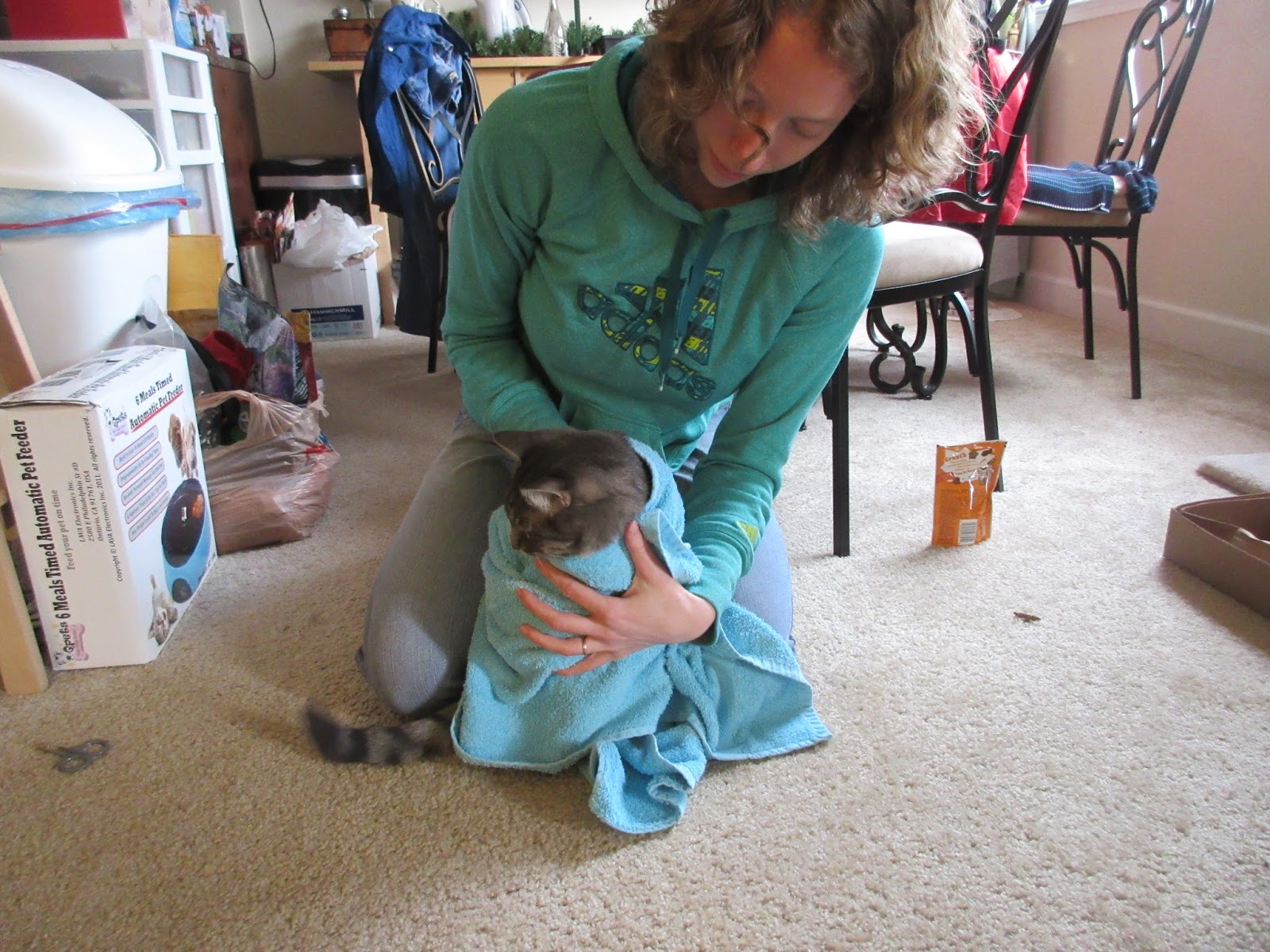
Towels are used for more feisty cats but the technique is roughly the same as the first method, just with additional layers between you and claws. It is also harder for the cat to move around when constrained by a towel, making it an even better method for holding a cat still during medicating or wound inspection. 

Step 1: Lure and distract 


If you can, lure the cat close to you with food. It is far easier to wrangle a cat that is distracted and within reaching distance. Though it is possible to toss a towel over a cornered cat, it is much harder, not to mention more stressful for you and the cat!

Step 2: Towel approach


Approach the cat with the towel from the side/back as shown. Keep your movements calm but swift, firm, and purposeful. Don't try to suddenly "attack" the cat with the towel. Instead, move the towel in and surround the cat with it in one smooth movement. Hopefully they're still eating treats!

Step 3: Pick up the cat burrito


Pick up the cat in the same way as you did for Method 1. The towel should further wrap around the bottom of the cat as you drag the cat toward you. You should still be grabbing them just under the armpits and still be in the same sitting position that you were in Method 1. There's just less of a chance of flying claws.

Step 4: Wrap the cat


Once the cat is facing away from you with their rear end constrained on either side by your legs, fold the towel around the front of the cat and hold it in place at the chest, just under the cat's chin. You now do not need to worry about holding the cat's shoulders down, as the towel can do that job with you just holding it firmly in one hand on the chest. This prevents the front escape, your body prevents the backwards escape. Inspect away! You can also use this method to get an unwilling cat into a carrier, or to hold an injured cat's limbs still, depending on how tightly you wrap the cat. 

As with the previous method it's best to practice this a few times first on a friendly cat in a relaxed mood where you don't actually need to do anything with the cat. Ticky gets treats for being such a good wrapping demonstration volunteer. He says "no problem!"


Method 3: Cat in a Sack

I would probably not use this one unless I was absolutely unable to confine the cat using the prior two methods or if the cat's wound was on the back end where it is hard to get to with towel wrapping. If the cat is prone to biting or is semi-feral  and wary about handling this is also a way to capture and inspect the cat. Its head is enclosed and the pillowcase can be opened around a single paw, for example, to get a closer look at it. Note that the cat can still breathe through the pillowcase (unless the pillowcase gets wet! Be careful about pillowcases that get wet- they can create suffocating conditions), and can see shadows of movement but not the environment around them. However, be warned that unless you have the pillowcase wrapped very tightly around the cat they can still move around and bite through the fabric. If you have a very vicious or feral cat, best to trap them in a humane trap and transport them to a vet to inspect!

Step 1: Distract and prepare

Bunch up the pillowcase behind the opening so it is smaller and easier to work with. Distract the cat with food and hover the pillowcase near their head to see if they are immediately frightened away. If that is the case then there is very little chance of actually getting it over the cat- pick a carrier or humane trap instead. 

Step 2: Capture


 If the cat is still distracted by the food, quickly place the bag over the cat, pushing the pillowcase edges all the way down to the ground over the cat's rear. The cat will immediately begin to back up, sometimes rapidly, shaking their head back and forth to try to get the pillowcase off. If you approach from the front and put the pillowcase on in this way the cat will always back up, so use this predictable response to your advantage.


Step 3: Block and tumble


When the cat backs up, tuck the pillowcase under their rear and grasp the far edge, pulling it toward you. This will flip the cat over onto its back. Do not do this in the air! Keep the pillowcase on the ground while flipping the cat to avoid injuries. Also do not open up the pillowcase. Keep it closed at the top to prevent the cat from escaping. You now have a very irritated cat in a bag, but it is a constrained cat, and one that is probably not biting or clawing your face off. You can now transport them safely to a cat carrier or wrap the cat more tightly to constrain them for inspection.

Not a step, but I wanted to reassure Ticky that me dumping him in a pillowcase was an alright thing to do. lol. He got lots of treats afterwards and only had to lick himself off indignantly for a few minutes.

"Well, this is new."

"I hope I get treats for this."

Method 4: Carrier or Humane Trap


If you're taking your cat somewhere and need them confined for the entire time, or if you're dealing with a feral cat then the best place for them is in a carrier. They are safe, no matter how wild they get, and you are protected as well. You can pick them up and take them wherever you need to and they have enough room to move around during a longer trip. If your cat is feral and doesn't allow you near them then a humane trap is basically a carrier that automatically closes behind the cat. ALWAYS remember to check a humane trap every hour or two. Do NOT leave a cat out in the elements while trapped. They can quickly dehydrate or overheat/freeze and die.

Step 1: Lure early and often
Treats make a carrier into a toy that only SOMEtimes takes him to the vet

The easiest way to get your cat into a carrier is to get them in it when you're not about to drag them to the vet. Leave your carrier out and use it regularly as a training tool. Toss treats into it at least once a week and get them used to going in and out of it, and get their scent into the carrier. This will make it insanely easier in an emergency. I had to get my cat quickly out of the building when a fire alarm went off in our apartment complex, and I just shoved him in there and closed the door. Easy peasy. When he started freaking out he was already contained.


Step 2: Contained!
Ticky is safe and portable in his cat carrier!

I hope this has been a useful tutorial on the different methods to contain a cat. I'd like to give a big thanks to Ticky for being such a good sport and J.D. for being the cameraman during my cat-containing antics. Ticky is sleeping on me as I write this, so he doesn't seem to hold a grudge. :)